
If Democracy Had a World Cup
Would we even make it out of the locker room?

Like millions of you, I spent many hours in the past month watching the World Cup. As usual, I was pulling for Uruguay, a place I’ve never visited but have admired for being the first South American country to legalize same-sex marriage, marijuana, abortion, and to outlaw salt shakers from being placed on restaurant tables in their capital, Montevideo. (Salt kills more people than salmonella.)
Yes, it was humiliating for the U.S. to be eliminated by perhaps the most boring country on Earth, Belgium. If America has to lose, I want us to be ripped to shreds by Wales or Vietnam or Greenland.
But here’s the thing I couldn’t stop thinking about while I watched our team walk off that field in defeat.
Sure, the rest of the world has been playing this game for a century or two! Of course they’re better than us! But there’s another competition that never gets a broadcast slot. It has no halftime show, no hydration break, no fake flopping where they pretend to be injured! In this other competition we’re often # 1 in the world — or we’re the best at being the worst. Either way, we’re the team that sets the bar!
This other game is called “The World Cup of Democracy” where only true Democracies can play. A special dispensation had to be granted to the U.S. for us to be included. In order to be declared a real “Democracy” your nation’s leader has to be elected by its citizens, not an “Electoral College.” Also, voting districts must not be gerrymandered. A “Democracy” cannot occupy other people’s land, nor can it be a theocracy.
The World Cup of Democracy allows these countries to compete against each other to discover which are the the best nations on Earth — the measure of which is determined by how well each one takes care of its own people and how well it treats the rest of the planet. Do mothers control their own reproductive health? Do their kids get enough healthy food to eat? Are their kids given a chance to go to college or learn a trade even if they lack the funds? Or, are they forced to live in a virtual debtor’s prison for simply wanting that education or training? How fair and equitable is your nation? How much do the wealthy call all the shots?
Let’s see how we each stack up in this new World Cup competition where, when it comes to freedom, human rights, equality, and making sure everyone has a seat at the table and a slice of the pie, that nation ranks among the best.
And to keep this fair, we are comparing only Democracies where people vote, the press prints what it believes to be truth and the government still manages to function, delivering all of life’s necessities.
Round 1: Home Ownership

Ah! The American Dream! The house, the yard, the dog. About 65% of us in the U.S. own our homes. And that puts us at No. 12 among the Democracies playing in this World Cup.
But that’s way behind Croatia, where roughly 91% of the people own their own homes. When Croatia declared independence after the breakup of Yugoslavia in the early 1990s, the government didn’t hand millions of state-owned apartments over to Wall Street or big real estate investors. Instead, it let the people already living in those homes buy them at steep discounts. The result? One of the highest homeownership rates in the world.
Norway isn’t far behind, with about 80% homeownership. For decades the country’s oil wealth has pumped millions into programs that actually help their citizens buy their own homes and make it actually possible for young first-time buyers to achieve their goal for practically nothing!
Maybe the American Dream isn’t disappearing. It’s just become easier to find it somewhere else.
(Sources: OECD country report, OECD Croatia report, U.S. Census Bureau Home Ownership Stats)
Round 2: Poverty? What poverty? In the richest country on Earth???
The relative poverty rate in the United States is around 18% — the highest among the democracies competing in the 2026 World Cup.
More than one in six Americans live in relative poverty.
That’s roughly more than twice the poverty rate in Belgium, Norway, France and the Netherlands.
Maybe winning the race to create the most billionaires isn’t worth it if what you’re really doing is trying to win the competition of how many of your neighbors you can leave behind.
Clearly, if the U.S. can make Elon Musk the world’s first trillionaire, there’s enough money to go around to ensure no American has to endure living in poverty.
(Sources: Organization for Economic Co-operation and Development (OECD), Confronting Poverty “Facts and Myths About America’s Poor,” Forbes)
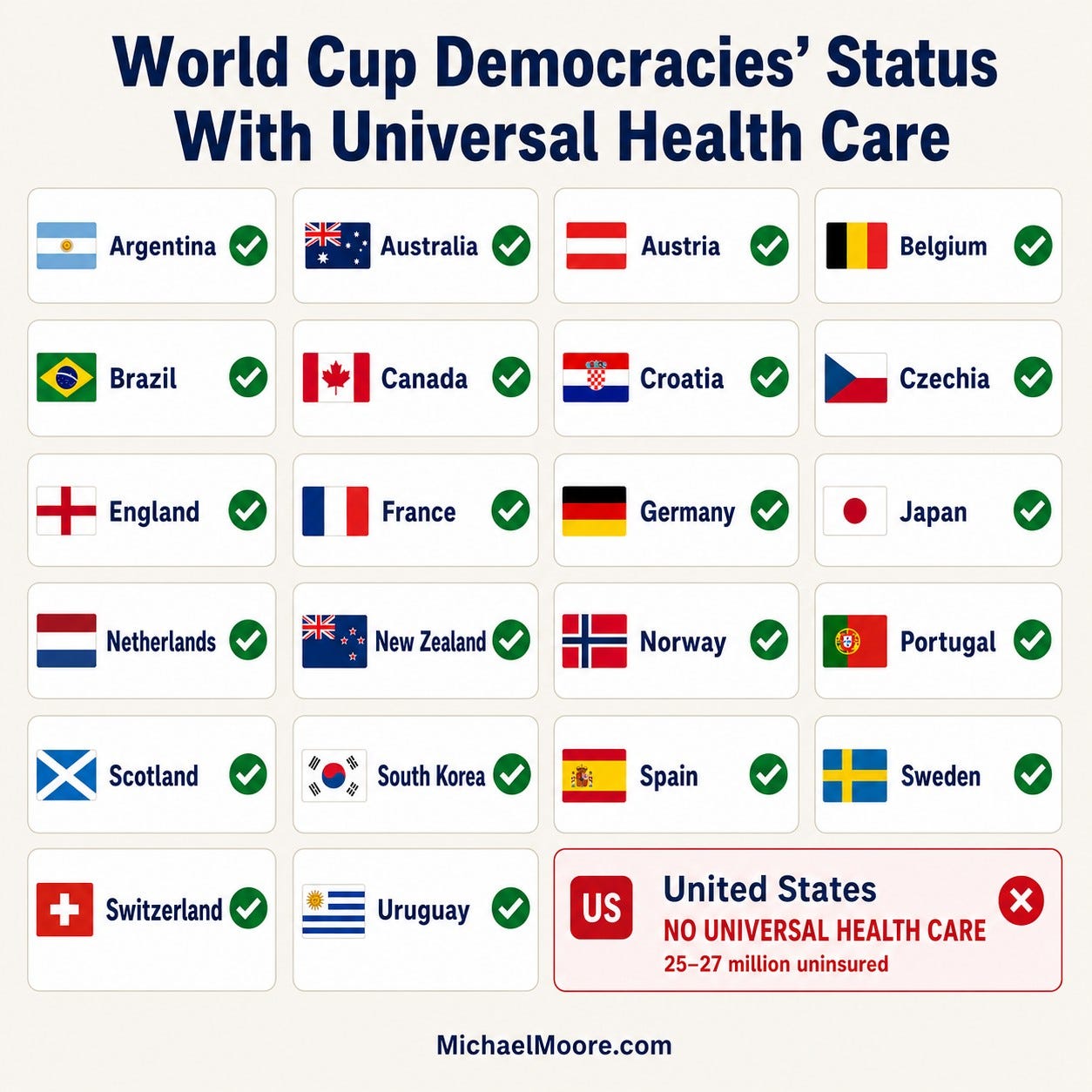
Round 3: Universal Health Care
What makes the poverty rate worse for us? ALL of the other Democracies playing in the World Cup have universal or near universal health-care coverage.
But wait, what about the Affordable Care Act (ACA)? Even with the ACA, roughly 26 million Americans remain uninsured. Without it, the uninsured population could potentially swell to nearly 60 million people!
Franklin Delano Roosevelt declared health care to be a human right in 1944. Eighty years later, the country that split the atom and put 12 humans on the moon still can’t manage what Uruguay figured out with three million people and a whole lot of cows.
(Sources: Congressional Budget Office, OECD, World Health Organization, U.S. Census Bureau, Health & Human Services, Social Security Administration, Physicians for a National Health Program, Public Broadcasting Service)
Round 4: College tuition
Average public university tuition in the U.S. runs around $11,000 a year. That’s before room, board, books, and the debt that follows you like a bad “Twilight” tattoo. In Norway, Germany and Austria, public college is essentially free. Free.
Let’s give college credit where it’s due. In France, undergraduate tuition is $200 a year or less. In Sweden, Scotland, Croatia, Argentina, Brazil and Uruguay, post secondary education is essentially free once you pay administrative fees.
How did that happen? These countries looked at higher education and said, “What if we just let our young people have it?” Radical concept, right? Never could happen in the U.S.? (Wait for an upcoming Substack. We’ve already done it, starting in Kalamazoo and in more than 300 cities and states across America.)
(Sources: OECD, U.S. Department of Education/National Center for Education Statistics, College Board: Trends in College Pricing 2025)
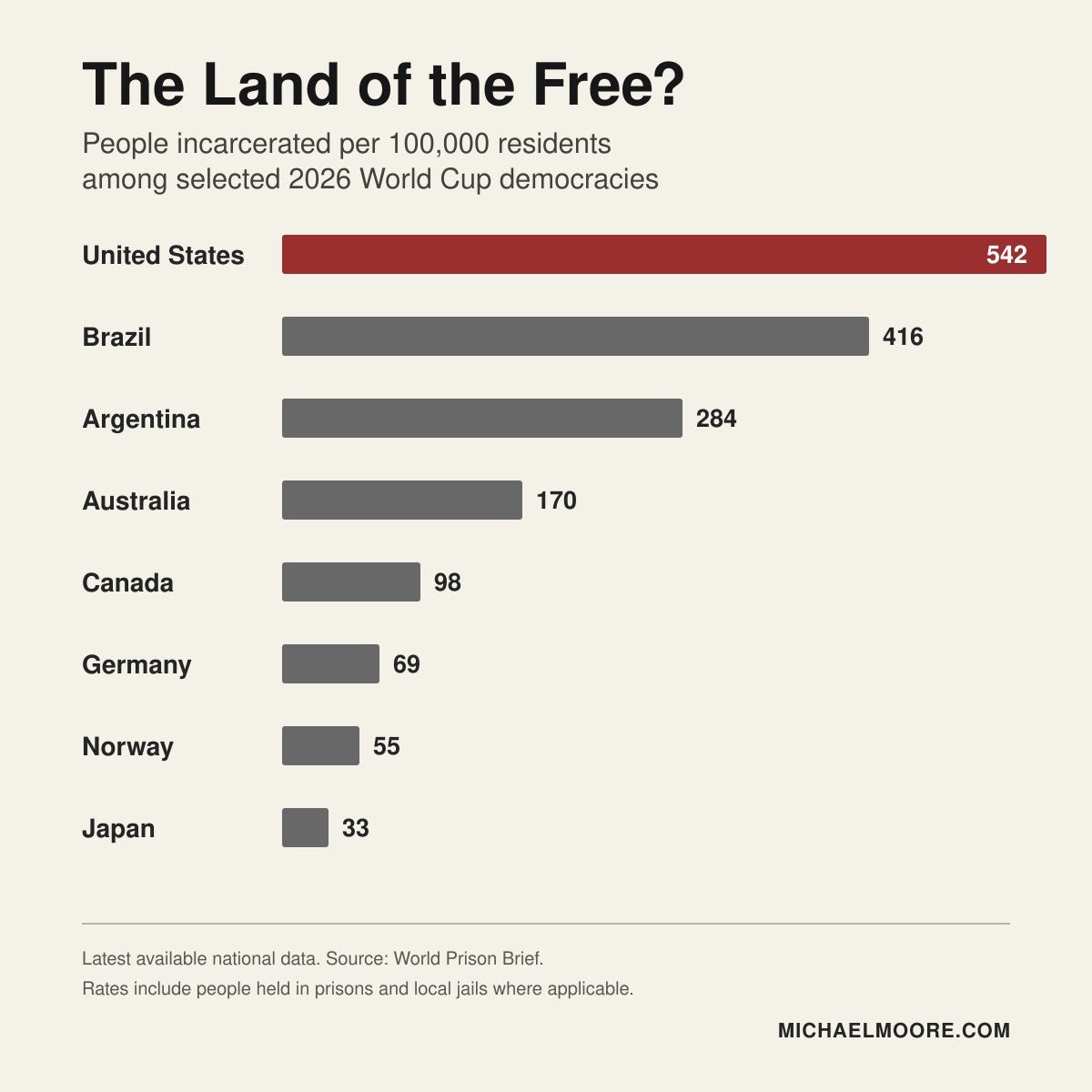
Round 5: Mass incarceration? We’re No. 1 at 1.83 million
It’s not just the number, but the rate at which we put people away.
We lock up around 540 of every 100,000 people, the highest rate among the democracies that played in this World Cup. That’s five times Canada’s rate, eight times Germany’s and nearly 10 times Norway’s. We call ourselves the land of the free but apparently, some restrictions apply.
The clear winner in this round? Japan: about 33 out of 100,000 people. We imprison our own people at roughly 16 times the rate of this fellow democracy. Japan has more than one-third of America’s population squeezed into a country smaller than California, yet somehow they don’t need to lock up their neighbors at anything remotely close to the rate we do.
We have only about 4% of the world’s population, but around 20% of the world’s incarcerated people. Anyone else want to join me in a chant of USA! USA! USA!
(Sources: World Prison Brief, Bureau of Justice Statistics, OpenCrime.us)
Now for serious numbers that are not a game

Round 6: Infant and Maternal Mortality in Wealthier Democracies
I want to slow down for the next two, because they’re not statistics to me, and they shouldn’t be to you, either. These are real people. In the 1950s, a dear friend’s mother had a job in Lansing typing up the state’s maternal and infant mortality reports. Number after number, hospital after hospital. She never forgot that each one was a family’s worst day.
Infant mortality
This sad statistic measures how many babies, out of every 1,000 born alive, die before their first birthday.
In the United States, that number is around 6.
In both Norway and Japan, it’s less than 2.
Sit with that.
A baby born in this country is roughly three times more likely to die before her first birthday than one born in Oslo or Kyoto.
Unless you’re African American, then it’s double the already dismal national rate, at 11 out of 1,000.
Same species, same century, but wildly different odds, decided by nothing other than where the stork landed.
Maternal mortality
This is how many mothers out of every 100,000 end up dying from causes related to pregnancy or childbirth, whether it’s while she’s carrying the baby, in the delivery room or up to six weeks after delivery.
In America, that number is 18.
In Norway, it’s 1.5.
Read that again.
This means an American woman is roughly 10 times more likely to die bringing a child into this world than a Norwegian woman. In the richest country in the history of countries.
Then you pull out the rate for African American women in the U.S., and it’s so much worse: 44 to 50, depending on the year and whose numbers you use.
One of the truest measures of a country’s success isn’t in the strength of its stock market or the might of its military, or even whether its team wins the World Cup. It’s whether mothers and children live. In other words: how well does a nation take care of the people who are the most vulnerable?
This is not a talent gap. This is not “the rest of the world has been playing longer.” This is a choice we keep making, election after election, budget after budget.
(Sources for maternal and infant mortality: World Health Organization/UNICEF, CDC, National Center for Health Statistics, OECD, NCBI)
So here’s where I land, friends.
I wasn’t sad on July 6th because we lost a game in the FIFA World Cup. C’mon, we lost to Belgium, a country with world-class players and, I’ll note, universal healthcare. No disgrace. Our players fought. Tillman’s free kick was a thing of beauty. We’ll be back in 2030.
I was sad because I know what we as Americans are capable of doing for one another. This is the country that built the interstate highways and invented the weekend. When we decide something matters, we know the good we can do.
Every one of the above countries is a democracy, just like us. Which means every one of the results I cited came from ordinary people recognizing what they need and want, demanding it and then voting out the people who wouldn’t give it to them to bring in the people who would.
That’s the good news buried in this dismal scoreboard: in a democracy, the fans get to pick the team.
I watched the final games last weekend. I know the half-time show was controversial but seeing Madonna, the Muppets and a rainbow of children from a local public school sing about love made me think our country becoming competitive in these stats can and should be more than a dream. Let’s start training for the games that decide whether babies live, whether kids graduate free of debt, and a future in which getting sick doesn’t cost you everything.
Isn’t it time to change that?
Yours in defeat (temporarily),
Michael
P.S. I put my film, “Sicko,” about the unequal health care system in America on YouTube. Watch it here for free.
Images: Graphics based on provided sources, aerial home image by Ameer Basheer, mother and child image by Raul Angel
** In order to have a troll-free, hate-free comments section — and because if there’s one thing I know about my crazy haters, they would rather spend an eternity in hell listening to J.D. Vance mansplain how to properly pronounce “Appalachia” while also droning on about his antics at Yale Law School rather than send me $5 — my Comments section here on my Substack is limited to paid subscribers. But, not to worry, anyone can send me their comments, opinions and thoughts by writing to me at mike@michaelmoore.com. I read every one of them, though obviously I can’t respond to all. The solution here is not optimal but it has worked and my Comments section has become a great meeting place for people wanting to discuss the ideas and issues I raise here. There is debate and disagreement, but it is refreshing to have it done with respect and civility, unfettered by the stench of bigotry and toxic levels of willful disinformation found elsewhere.
Such great info. I will share. And it's wonderful to see you writing again.
Thank you, Michael. It’s so good to hear your voice again. As disheartening as these statistics are, the fact that you are publishing them gives me hope. Please keep up the good work!